
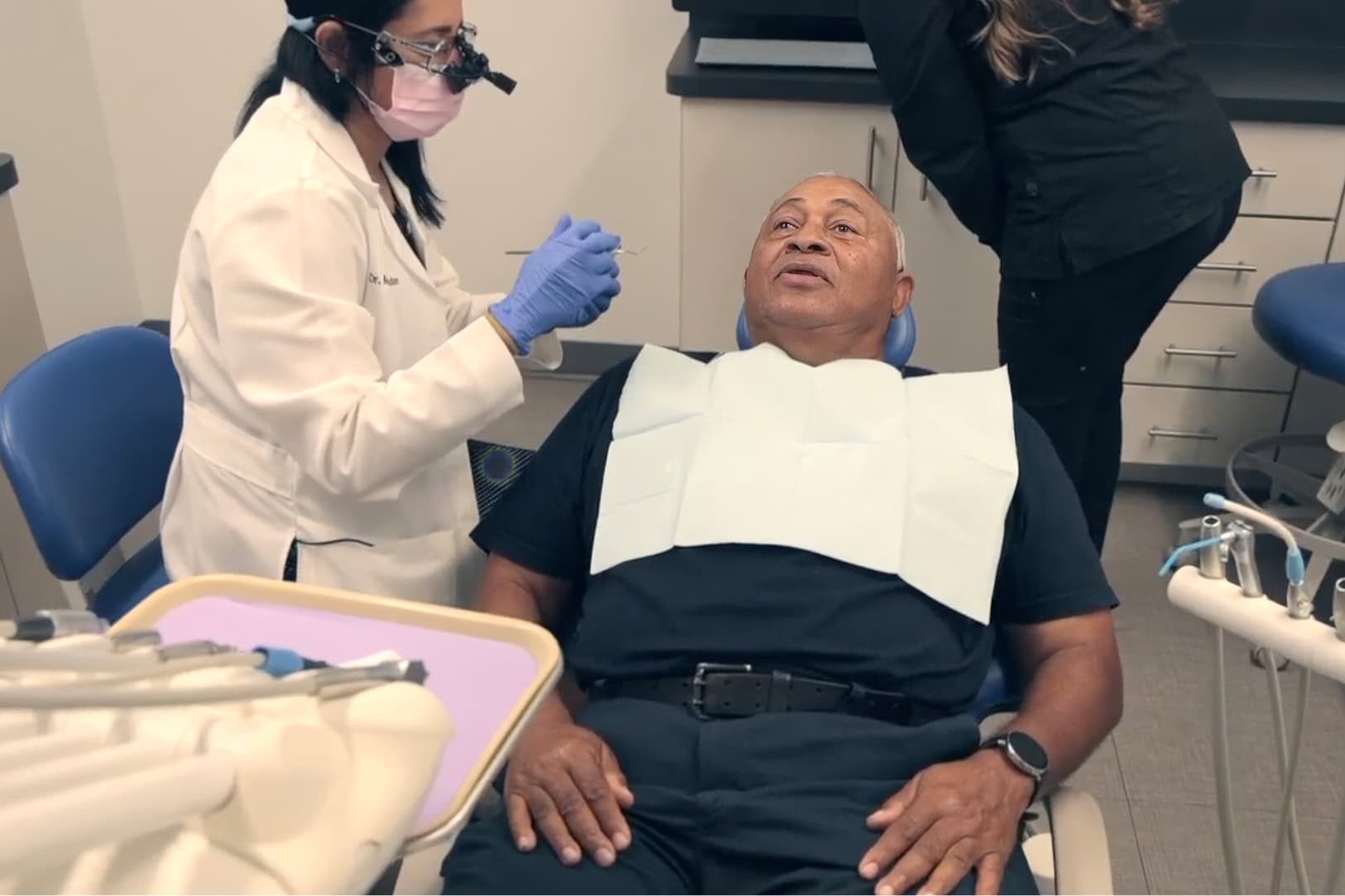
Roughly One in Four Orthodontic Patients Is an Adult
Teeth respond to steady pressure at any age. The biology that moves a fourteen-year-old's teeth moves a forty-five-year-old's — somewhat more slowly, and with a few extra considerations, but the result is the same. Plenty of our Hampton patients are treating something that has bothered them for twenty years, or fixing relapse from braces they had as a teenager and stopped wearing retainers for.
What Is Different About Adult Treatment
Growth is finished. In children we can guide jaw development. In adults, skeletal discrepancies are corrected by moving teeth, camouflaging the difference, or in significant cases combining orthodontics with surgery. We will be direct about which category your case falls into.
Existing dental work matters. Crowns, bridges, implants and fillings all affect planning. Implants do not move — they anchor — so their position shapes the plan.
Gum health comes first. Moving teeth through inflamed or receding tissue makes things worse. If you have periodontal issues, we treat those first; our periodontics team handles that in-house, which keeps the two halves of your care coordinated.
Treatment tends to run a bit longer, often modestly — not dramatically.
Discreet Options Exist
Clear aligners are removable for meetings and meals and are effectively invisible. Ceramic brackets blend with tooth color and stay put, which suits complex cases that aligners handle poorly. Traditional metal is the most efficient and least expensive. All three are legitimate; the honest question is which fits your case, not which looks best in a brochure.
What It Actually Fixes
Crowding that traps plaque and makes flossing a chore. Bite problems that wear enamel unevenly or strain the jaw. Gaps from long-ago extractions. Preparing the mouth for implants or crowns so the restoration sits correctly.
Why Adults Come In
The reasons cluster into three groups, and they call for different conversations. The first is appearance - something that has bothered someone for two decades and has finally reached the top of the list. The second is relapse: braces at fourteen, retainers abandoned at sixteen, and lower front teeth that have quietly crowded ever since. The third is function - a bite that wears enamel unevenly, or teeth that need straightening before restorative work can be done properly.
Relapse cases are often the shortest and least expensive, particularly where the underlying bite is still sound. If that is you, the honest news is usually better than you expect.
Gum Health Is the Non-Negotiable
This is the one place we will slow a plan down. Moving teeth through inflamed tissue or reduced bone support costs attachment that does not come back, and the loss is permanent.
If you have had gum treatment, or your dentist has mentioned recession or deep pockets, expect us to stabilise that first. Having our periodontal team in the same practice makes this coordination straightforward rather than a referral chain, and in some cases it changes the plan itself - favouring lighter forces and a longer timeline to protect the support you have.
Working Around Existing Dental Work
Adults arrive with history, and every piece of it affects planning. Implants do not move, so they anchor rather than shift and the plan has to accommodate their position. Crowns need care when bonding brackets. Bridges may need to come apart if the teeth they span must move independently. And restorations on the front teeth are often better replaced after straightening, when they can be made more conservative.
None of this is an obstacle. It is the reason adult planning takes longer at the consultation stage than it does for a teenager.
How Much Longer Does It Take?
Somewhat, in many cases. Adult bone remodels more slowly than a growing child's, so movements take a little more time. The difference is measured in months rather than years, and case complexity matters far more than age does.
What we will not do is quote you a dramatically shortened timeline. Vibration devices have not held up in controlled comparisons, and light therapy remains unsettled. Bone remodels at the pace it remodels, and any plan promising to beat that deserves a direct question about what it leaves uncorrected.
Work, Speaking and Daily Life
Most adults worry about how it will look in meetings, and the worry is generally larger than the reality. Ceramic brackets attract very little attention in conversation, and any speech effect from aligners resolves within a week or two.
Plan around the first week if you have something important scheduled, and expect a day or two of soreness after each adjustment. For most people that is the full extent of the disruption.
The Trade-Off With Aligners
Aligners suit many adult cases and are the most discreet option available. But they depend entirely on twenty to twenty-two hours of daily wear, and adult schedules are exactly what makes that hard - long lunches, client dinners, a tray left in a napkin at a restaurant.
Be honest with yourself about that before choosing. Brackets work whether or not you remember them, and for someone who knows they will not keep a habit for eighteen months, that reliability is worth more than the discretion.
Retention Is the Part Adults Underestimate
Most adult patients in our chairs had braces once already, and the difference the second time is not the treatment - it is the retainer. Nightly wear, indefinitely, usually with a fixed wire behind the lower front teeth as well as a removable retainer.
Teeth drift throughout adult life whether or not they were ever treated. Retention is the only thing that holds a result across decades, and it is the reason a second course of treatment should be the last one.
What to Bring
Your insurance card and plan details, a list of medications, the name of your general dentist, and any recent X-rays another office holds. Mention any planned work on the front teeth, because sequencing matters.
One Question Worth Asking Yourself First
What specifically bothers you, and what would count as a good result? Adults are far better than teenagers at articulating this, and the answer genuinely shapes the plan - a patient whose concern is two crowded lower incisors needs a different conversation from one who dislikes the whole smile.
Bring that answer with you. It is more useful than any image you have saved.
Start With a Consultation
We see adults from across Hampton and the Peninsula. Learn about our Hampton orthodontic care, or request a consultation and we will tell you plainly what is possible.